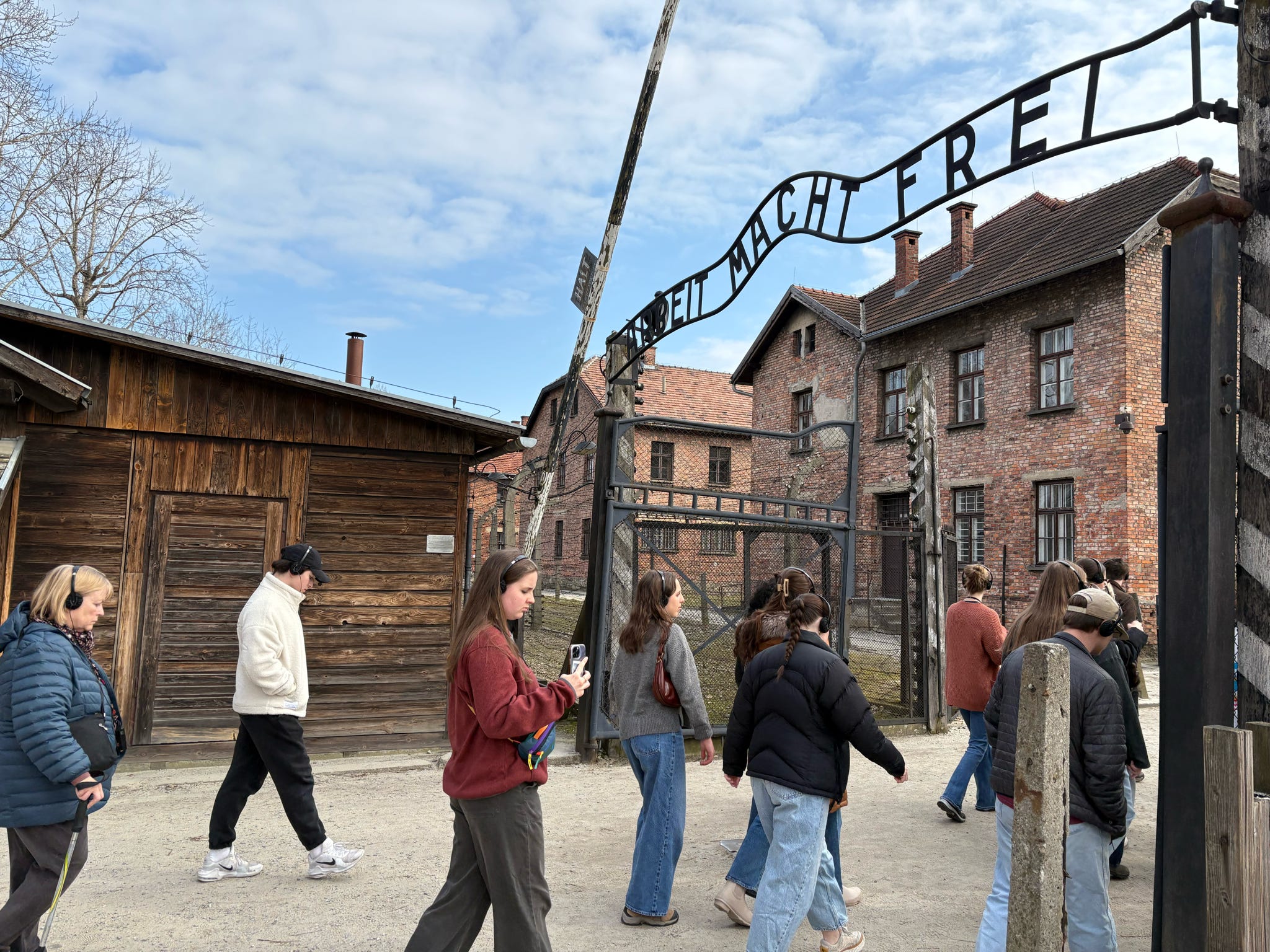
Last week, the Oklahoma Christian University Vienna study abroad program took a group trip to Krakow, Poland. Students had the opportunity to experience Polish culture through a historical walking tour and a group dinner at a local Polish restaurant. While students were able to have fun and explore the historic Polish city, they were also guided through a tour of some of the most troubling aspects of human history at the Auschwitz memorial site in Oświęcim, Poland.
Presley Linge, a sophomore majoring in finance with minors in international business and German at Lipscomb University, is participating in the Vienna program this spring semester. Linge talked about her preparation for the trip to Auschwitz.
“We had quite a few discussions with our site director Ashley, just mentally preparing us for what was to be expected from Auschwitz, so that we would be emotionally ready as best we could. Some of us are in the ‘Psychology of the Holocaust’ class, which has really opened our eyes to the Holocaust. The atrocities of it and what we were really walking into, and how impactful it really is on history,” Linge said. “I’m never going to be able to read another Holocaust book, or learn about the Holocaust and not know that I stood there. I mean, I’ve stood where they stood, whether they lived or didn’t. I stood there, and it could have just as easily been our generation. It could have just as easily been us that was experiencing those things or doing those things,” Linge said.
On the day the tour took place, the temperature in Oświęcim was unusually warm for the time of year. There were very few clouds in the sky, with little to no wind. Linge talked about her feelings on the contrast of the weather and the weight of the day.
“What really shocked me was how beautiful it was outside, and that the trees in Auschwitz I were just gorgeous. It was sunny. There weren’t very many clouds, and there’s just the irony of it, that in such a horrible place, there could still be such beauty and that that could lead to such hope. And then also the contrast of that in Auschwitz II, when there were no trees and it really did feel like a mass grave yard, especially seeing the remains of the wooden barracks. It felt like a graveyard, but it was still a beautiful day, and that seemed kind of a cruel irony,” Linge said.
“The nature surrounding Auschwitz was really shocking, and I don’t expect that to hit me as hard as it did. Especially when we walked into the gas chamber and Auschwitz I, choosing to walk in, knowing that we were still going to get to walk out. So many people didn’t get that choice, and didn’t walk out. Looking up and seeing the sky and knowing that for so many people, that was the last time they got to do that, the beauty of nature was really shocking to me,” Linge said.
After the trip to the memorial site, program leaders prompted discussion to guide students to reflect on their experience at Auschwitz. Linge reflected on the ways the visit to Auschwitz prompted her own spiritual confrontation.
“For me personally, my faith was challenged in knowing that every single person in that camp was loved by God, not just the victims, but also the perpetrators, and that they’re made in His image as well. It’s hard to see pictures of a Nazi smiling while people are being sent to their death, and know that all those people being sent to their death are loved and made in God’s image, but so is that person smiling about it, and that’s just really hard for me to wrap my head around,” Linge said.
“I think a big question is, you know, ‘how can such evil exist in a world that God created?’ And ‘how is He still good and loving, but allow that to happen?’ And so many people have different explanations of the ‘why’, but I don’t think we can ever truly understand it. But really it comes down to we all have free will, and that’s not much comfort, but because He loves us, He gives us free will, and we have abused that,” Linge said.
“It really makes you realize the extent of human suffering, and that makes you really reflect on what Jesus went through, you really start to understand. I mean, you can’t fully understand because it’s not happening to you, but you understand better what it means to be beaten, what it means to be, you know, walk to your death. It was different, because obviously Christ had a choice, but it was still brutal and it really displays the destructive tendencies of humanity. Knowing that the perpetrators in Auschwitz were made in God’s image. God also saw that in the people who killed His Son, and He loved those people, and He still chose to die for them,” Linge said.
Dr Kevin Simpson, distinguished professor of psychology at John Brown University is teaching as a visiting faculty at Das Millicanhaus for the spring study abroad semester.
“So this is a course that I’ve taught back home at James Brown University. It’s a full semester course that I’ve kind of condensed to this format, basically psychology of the Holocaust. It’s a whole lot of history and a sprinkling of social science, primarily psychology. We look at [the Holocaust], and we try to explain why it happened, and consider all the different perspectives, including perpetrators, bystanders, victims, observers, onlookers, that kind of thing,” Simpson said.
While Simpson’s course is unique to this semester, the Vienna study abroad program makes the trip to the Auschwitz site each Fall and Spring semester. Simpson has an extensive background in Holocaust studies and has led multiple groups through Auschwitz and other sites during his time as an educator of this history and psychology. Simpson talked about his experience leading groups through sites like Auschwitz.
“When I take students… I try to let them experience it individually and not get in the way with too much information, because certainly the wonderful tour guides do a pretty thorough job of that. I anticipate that students will feel overwhelmed, both intellectually and emotionally. So I try to fill the spaces in between with questions they might have or little details that might help them understand differently or uniquely,” Simpson said. “I didn’t want to get in the way of the professional tour guide, but I also just want to be present and not be closed off. When you visit places like these, it’s really easy to go into self protection mode and not be available to new learning. And every time I’ve been there, I’ve learned something new. So I kind of prepared my mind and my heart for that going into it,” Simpson said.
Simpson led students in their reflection of the site visit after they returned from Auschwitz to help them process what they had just experienced in a healthy way.
“I prepared some scriptures, and some thoughts regarding lament in the Holocaust. “Psalms 88 was, I think, a meaningful scripture to use there, David’s reflecting on his lament. One thing I think a lot of Christian students don’t realize is that there’s been a really long tradition of arguing and contesting with God, and that certainly fits when you talk about the Holocaust. A number of people lost their faith, gave up their faith because they saw God as absent. Others had their faith affirmed, especially if they had glimpses of the divine in someone’s humanistic behavior towards them, rescue behavior, saving them, something like that. So for me, it was just trying to keep it within that boundary of reflecting on lament, having us do a little bit of that, and then just see where students’ emotions take them,” Simpson said.
“My hope is that they can start to make some significant and consistent connections between this history that’s basically 80, 90 years old at this point, to events and current issues in our own time, that there are commonalities, between the hate and the indifference that made the Holocaust possible, to some of the things we struggle with in our own times. That is one of the most important end goals or hopes, is that it doesn’t stay in a box. It doesn’t stay in a history box,” Simpson said.
“And this is what I love about college students, your guys’s idealism inspires me. So what I hope for is that students start to see themselves as part of a bigger global community. The fancy phrase is, how do we build citizenship in students? But it really is about, especially for American students, seeing beyond our own borders. We live in this globalized world, and we’re seeing pressures on that nowadays, nationalism and the re-emergence of ideas that build walls between us. We talk about this in social psych all the time. Sometimes the demagogues, the people who want to separate us, divide us, create fear in us. They like to build up the ‘other’ as a threat. So we have a lot of fear in our time and age, and I want to push back against that. So I hope students start to see why that matters, to reject fear,” Simpson said.
Simpson shared the ways his faith in Christ is affirmed in his research of the Holocaust.
“Given that I’ve studied the Holocaust and traveled to so many places of immense suffering and horrors, my faith is affirmed in a couple of ways. I realize that I’m no better than the people who perpetrated these crimes, and so I come back to this reminder that my own failings remind me of my need for Christ. Invariably, when I visit these places, especially Auschwitz, I get angry, and it seems like I should be past that emotion, but it’s the anger for our human depravity that was unrestrained, basically, which is again a reminder for me that I need to be, as much as I can, seeking redemptive support,” Simpson said.
The Vienna program is half way through its completion and students will continue to dive deeper into their understanding of the Holocaust during Simpson’s course, and beyond.

Be First to Comment