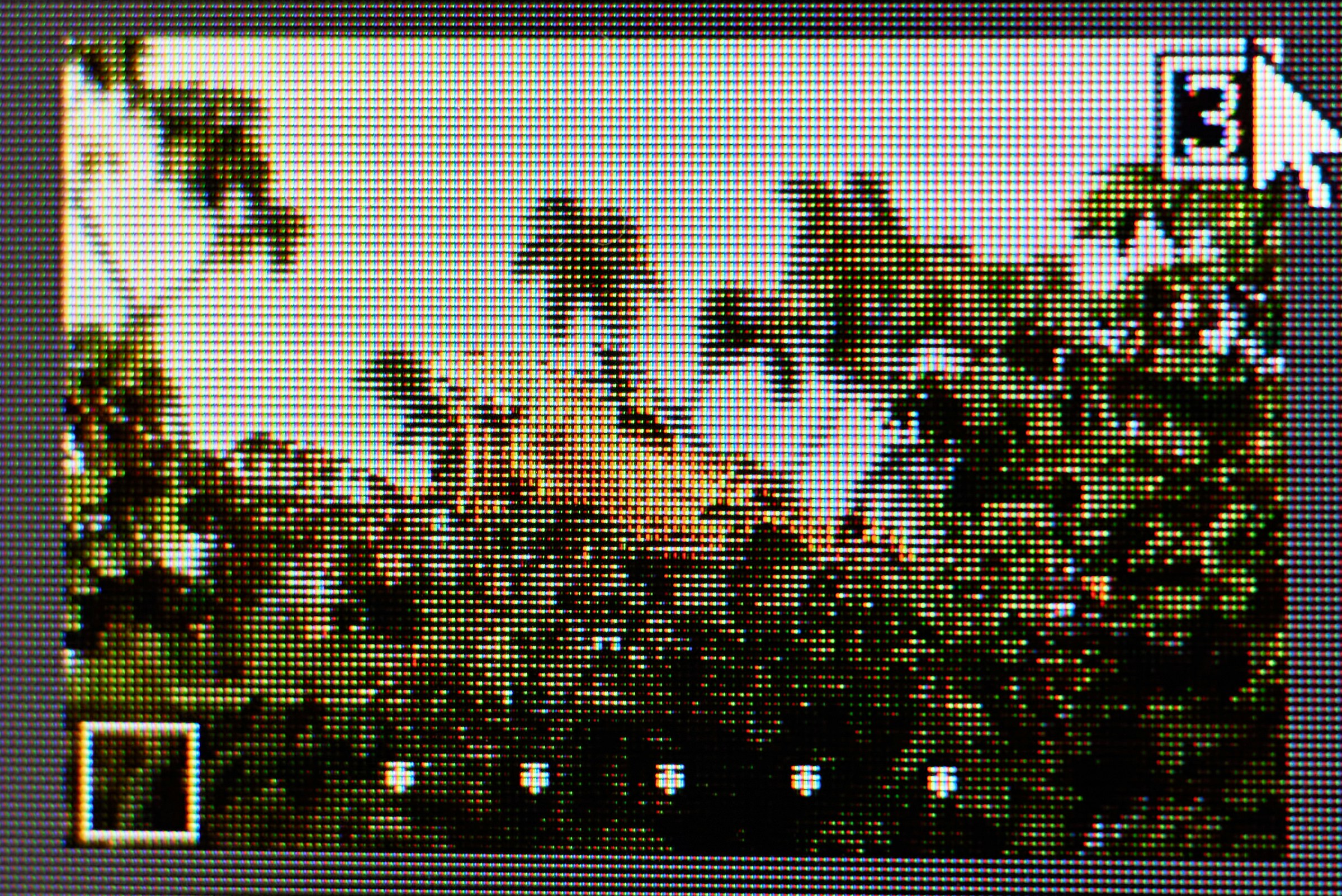
In the technological world, another advancement has been made. Oklahoma Christian University Professor of Computer Science Dr. Fang Li has submitted a provisional patent for his new ImageCFN file type; CFN stands for “compositional function network”. This file type will eliminate pixelated images, wonky webpage displays, and advance image generation AI models. The Talon interviewed Dr. Li and asked him to explain this brand new breakthrough.
“My name is Fang Li, and I joined [Oklahoma Christian] spring of 2022, so right now is my fifth year. I’m currently in the position of assistant professor of computer science,” Dr. Li said.
“Image CFN is an interesting project, so it’s basically just breaking the conventional way of representing a picture, an image, in the past about like 30 or 50 years,” Dr. Li said.
Images are normally displayed on a screen using pixels. The resolution of a photo is dependent on the amount of pixel information available.
“Computer images, your cell phone, and your computer are all digitized. So how we represent that is by using pixels, right? Basically it’s a matrix, so you’ve got many rows and columns, and you always see the resolution, like 800×600… Those are referencing the size of the matrices. 800 multiplied by 600 means like you’ve got 800 rows and 600 columns… So the idea is, if you zoom in, you will eventually see the pixels,” Dr. Li said.
Pictures that do not originate from a digital format, however, are viewed differently when blown up. Image CFN behaves similarly.
“If you ever got a chance to look at the old pictures in your family album, you can use a magnifying glass, and you don’t see pixels, right? Because those are optical. They use film to sense the optical stuff, reflect the thing, and just frame the scene. So on my image CFN project, we encode. We encode the image. Of course we need to take the digital input first, so we get a PNG file, for example, which is considered the highest quality of the digital image. And then we are able to convert it into a mathematical expression. So it is no longer pixels. It is a pure math function. So if you just tell the function the input of the (x,y) coordinates, it will tell you what kind of color this dot should be. You don’t need to worry about 800×600. It’s a continuous function; you have put whatever location coordinates into that function, and it will give you the correct color for that specific location,” Dr. Li said.
To try out the new file format, click the link and upload an image to convert: https://lnkd.in/gx-7FCrR.
The applications for this technology are numerous, but most useful is its utilization in webpage design, Dr. Li explains.
“The best thing for this is, for example, right now for every website, there are a lot of pictures, right? But you can use your cell phone or use a different computer to visit that web page, so it must adjust to different device resolutions… What [businesses and companies] are doing is the website will prepare at least five different copies of different resolutions. But with the ImageCFN file type, we can just use one. Because of the mathematical function, the browser is able to read your local computer’s resolution, so it will pass the information to our decoder. A decoder will just render the whole thing dynamically. So that means for like Instagram or Facebook, those webpages, they no longer need to save five copies of images; they only need to save one,” Dr. Li said.
This image file has several perks to it. It is much smaller than a PNG or JPEG file, taking up 3.8 times less space than the original image size. Additionally, it creates another form of learning material for generative AIs.
“Actually, it is compression, so it’s not the original size. So far, based on my picture marking, I found that it’s, on average, about 3.8 times smaller than the original one. So it’s much smaller, and it’s very high quality so far…. So this is one of the advantages to it. So the other advantage is, because this [file] is like a mathematical expression for the image, we are able to use this image as the training material for image generation. Right now the image generation is a bottleneck because they already used all of the human content created to train their model. They’ve started doing synthetic data. But if the industry sees, or the academia sees, our approach, they can use our image representation, the ImageCFN, as their input. So instead of learning the random pixel distributions, they learn the mathematical semantics for the picture,” Dr. Li said.
Image CFN is not the first attempt at creating this type of technology. Other major corporations such as Facebook also have attempted similar advancements.
“Why the Image CFN is good right now is because some other people did similar things. Like Facebook or Meta, they did a system. They use an approach called the INR. INR is Implicit Neural Representation of images, but they basically train the neural network on the image. But the thing is, it takes them about like 50 minutes to encode a picture. But my ImageCFN only takes, on average, 1.2 seconds. Encoding takes 1.2 seconds, but the decoding is almost real time, so it’s very fast,” Dr. Li said.
When asked about the journey leading up to this breakthrough, Dr. Li explained his motivation for the project was a desire to make some fundamental change in the world.
“From the very early days, when I started my study in computer science, I was always hoping to make some fundamental change. Because right now, I see a lot of people doing research and academia or the industry, they’re all doing incremental stuff they want. They’re always doing stuff based on other people’s work. They want to push a little bit forward. Well, I was thinking that, ‘Hey, we might need to solve some fundamental problem right?’ …Everybody knows that the dot, the matrix, is not the real reflection of our real world, right? So I always want to make some image representation, or some other representation for fundamental research,” Dr. Li said.
“ImageCFN is a fundamental change. It’s not like a standalone software. It’s gonna be the standard. For example, right now, you use your computer…you see JPEG, PNG, or WebP. Those are the basic standards for the user. You don’t need to do anything for this, because this one will be adopted by the industry. So when it’s being adopted by industry, that means, like, your computer OS will integrate and will have the built-in decoder to review, to look at the picture,” Dr. Li said.
A word of encouragement was given to others who also share the desire to change the world around them.
“I always want to say to be creative and work hard. It doesn’t matter where you are. Being a professor, a Christian professor at a small teaching school, I am still able to make world-changing innovations. I want to encourage all my students and colleagues, or any people who want to make a change to this world. Just do it,” Dr. Li said.





Be First to Comment