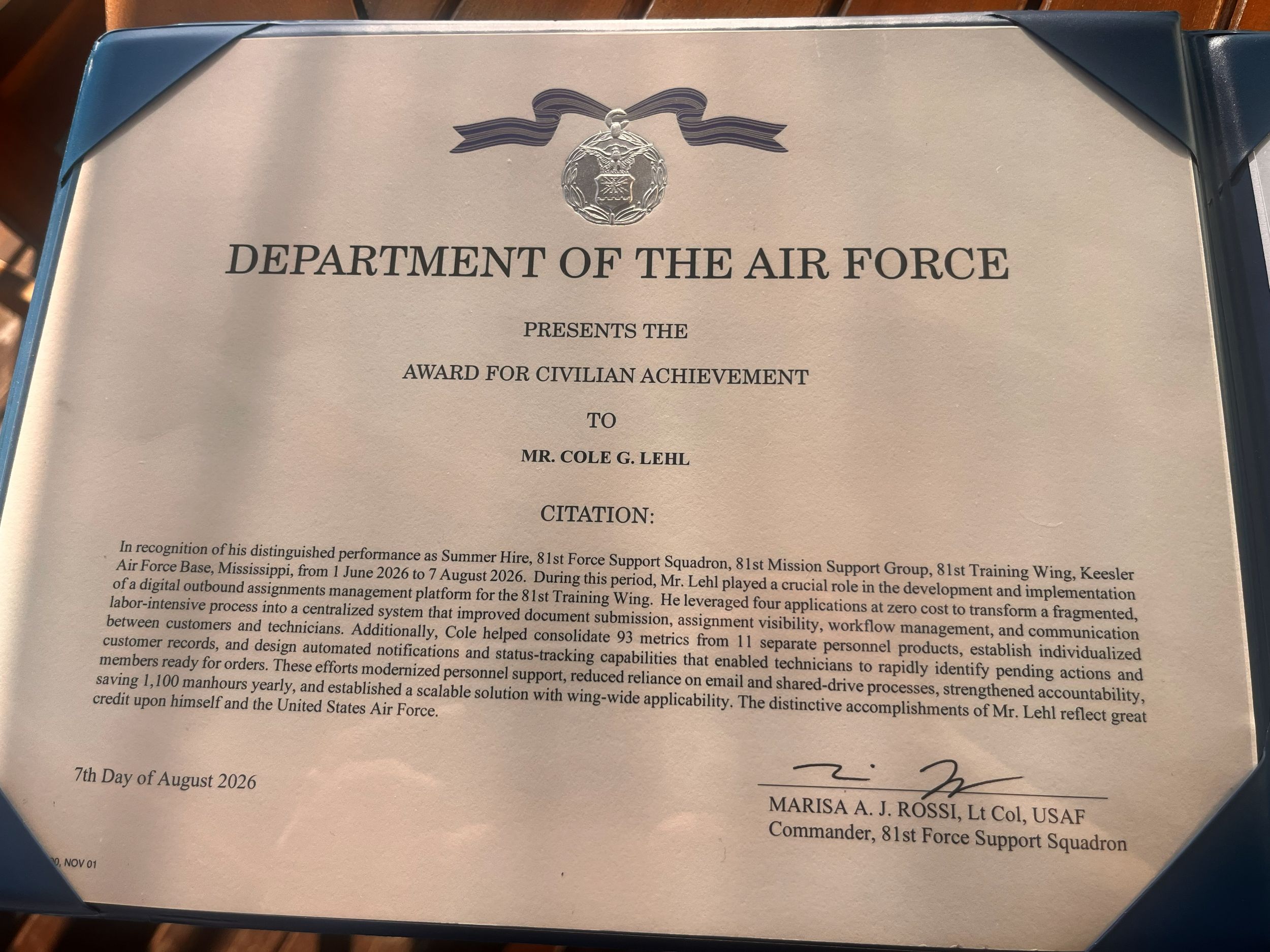
This summer, cybersecurity sophomore Cole Lehl earned the U.S. Air Force Award for Civilian Achievement at his internship with Keesler Air Force Base in Mississippi.
The Award for Civilian Achievement recognizes civilian employees for a specific act or accomplishment exceeding expectations to support their unit’s mission.
Lehl spent his internship working on a Virtual Military Personnel Flight database.
“It tracked who was going where, when they had to be there, and what the departure date was,” Lehl said. “The MPF I was working on was for the regular support personnel, for the 300 to 500 actual staffers that were in the base, rather than the trainees.”
Natural curiosity and excitement to work on real-world problems led Lehl to pursue an internship with the Air Force.
“What drove me there was my excitement to work on something like this, but also I have a natural curiosity,” Lehl said. “I like learning stuff. If I’m interested in something, I’ll learn about it. It’s fun. It’s interesting. For instance, to learn Java before OOP (Object-Oriented Programming) started, I made a life simulator. It was very bad, but I learned Java.”
Lehl first developed an interest in programming when he was 12 to 13 years old and learned Python from a family friend.
“My father had a friend who essentially got me into programming as a kid,” Lehl said. “I was interested in this, and my parents realized, ‘He really likes electronics,’ and I started to learn Python. I got an old Lenovo ThinkPad for Christmas with Ubuntu on it. My first operating system was Linux.”
Tinkering with software is the best way to learn, according to Lehl who came to Oklahoma Christian University prepared with a substantial computer science background.
“I can’t tell you how many Discord bots I’ve made in Python just to make them,” Lehl said. “They’re stupid, funny, and useless, but I learned programming from them. I’ve probably learned more over the years from messing around and doing dumb projects than I have from actual classes. Classes teach me basics, but I’ve learned more actual, usable, in-depth knowledge from the stuff I do with projects.”
Lehl competed in the National Cyber League with Oklahoma Christian in 2026, and his team placed in the top 10% nationwide.
“It definitely gave me the mental picture for trying to imagine, ‘Okay, if I wanted to break into this, how would I do it?’” Lehl said. “That made me make certain decisions to make everything more locked down and secure. I had to change things around to allow it to be more secure and confined.”
He intends to pursue a career with the U.S. military and disagrees with people who are averse to government work.
“Going for the military might seem like a last resort because there are a lot of people who look at the government as lame or poor jobs, which it is anything but,” Lehl said. “I don’t know where that stereotype comes from, because the pay is excellent, the people are amazing, and, essentially, your HR is the U.S. government. What more could you ask for?”
Professor Glen Davis commented on how Lehl’s programming background stuck out in his first classes at Oklahoma Christian.
“The background knowledge he came in with was already more than what some of those kids had at the end of the course; he had more than that when he came in, you know,” Davis said.
Lehl’s enthusiasm to go deeper than the minimum requirements and practically understand material has impressed Davis.
“He’s very curious, which is good. I like to see that, and I encourage that,” Davis said. “But don’t lose sight of the mission first; get that done, and then go do the other stuff. He’s very enthusiastic about jumping into that other stuff.”
Davis believes Lehl’s drive encourages other students and elevates the computer science program at Oklahoma Christian.
“People like that kind of inspire other students,” Davis said. “’Oh, well, I didn’t realize, how’d you do that?’ or, ‘Oh, I better step up my game. There’s other people that are doing this stuff. I don’t have any excuses.’ It makes other people want to step up.”





Be First to Comment