
After decades of steady growth, nationwide tech layoffs and shifting immigration policies threaten computer science enrollment at Oklahoma Christian University. To keep graduates competitive, professors adapt their courses to navigate new AI technologies.
“We’re experiencing a decline in computer science enrollment at OC the last two years. I’ve noticed it,” said David North, chair of the computer science department. “It’s a pretty significant decline.”
North attributes part of the declining enrollment rates to changes in immigration enforcement, which make it harder for the international students who recently comprised around 25% of graduating classes to secure visas. Advice from high school counselors, parents and news agencies that computer science jobs are few may also affect student decisions, according to North.
“During COVID, all the tech companies hired lots of people because the demand for online services went through the roof,” North said. “That demand has either been satisfied or has declined some, so they have started letting people go. There are more people chasing after the jobs, so that makes it harder to get jobs.”
While some companies blame AI for layoffs, North argues many have not actually figured out how to replace engineers with it.
“If I’m going to lay people off, if I say it’s because of AI, that makes people think I’m smart, and I’m using AI, and I’m more effective and more efficient, and I can build my products for less. And so, my stock price will go up,” North said. “You get positive bounce in the stock market for that kind of positioning.”
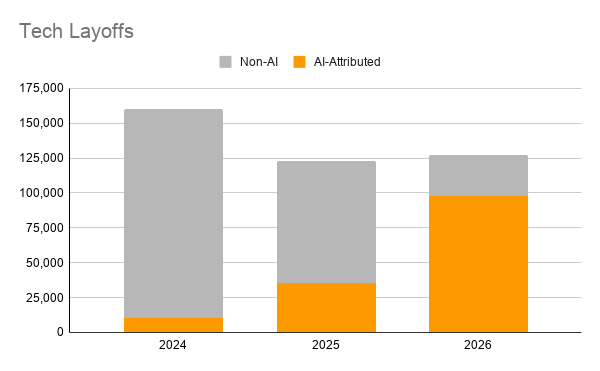
Whether they have figured out how to use it effectively or not, many software companies are rolling out AI development workflows, driving colleges to implement the technology in their curriculum. To adapt to the new technology, the department prohibits AI in early courses to ensure students learn foundational skills before reaching upper-division courses where AI integration is left up to the discretion of instructors.
North said he is confident software development will continue to require humans to understand and solve problems.
“The problem isn’t just written on the wall somewhere that we can read it off and feed it into the computer,” North said. “You have to go out and talk to people and interview people and go watch what they’re doing.”
While market rumors may deter some, professor Daniel Griffin notes those who stay in the major are driven by more than family advice or what they see on the news.
“If I asked the seniors why they chose computer science, most of them would not say ‘cause my uncle told me to,’ or ‘I heard it in the news,’” Griffin said. “They’d have some other reason for their interest in computer science.”
Griffin structured last semester’s mobile app development class with two tracks: one focused on traditional development and one dedicated to coding with AI.
“It gave students the autonomy to choose: ‘Do I want to work on my AI prompting skills and my AI engineering, or do I want to work on learning the details of the language and the details of mobile apps in a more detailed way,’” Griffin said.
Griffin also teaches a general AI technologies class built to help students from all majors master AI in a business context. He believes the emergence of AI will make software development more efficient, allowing engineers to focus on new kinds of projects.
“There’s a concept that I keep thinking about called Jevons paradox,” Griffin said. “As we become more efficient, the amount of work we need per task goes down. The paradox comes in because we get below a certain threshold and more work shows up that we wouldn’t have done otherwise.”
Griffin compared the shift brought about by AI to the advent of WordPress. The new website-building software made website design more accessible to the general public, allowing software developers to prioritize work in a newer area: building web apps.
Robert Burke, a third-year computer science student and Department of Defense SMART Scholar, said Oklahoma Christian is integrating AI heavily into curriculum, especially Software Engineering IV, where AI is a main focus of the class.
“OC’s trying and is very good at staying on the edge of technology in a lot of ways while still learning the fundamentals,” Burke said.
Burke is confident in the future of computer science, comparing AI advancement to the Industrial Revolution.
“It’s very similar to the Industrial Revolution when people were losing their jobs,” Burke said. “The Luddites were the people who rejected that huge industrial progress and they’re the people who suffered. If you do not adapt, then the concerns you have are true.”
Oklahoma Christian’s computer science programs will continue to change and adapt as AI advances because, as North notes, everyone is still figuring out how to use it effectively.







Be First to Comment