
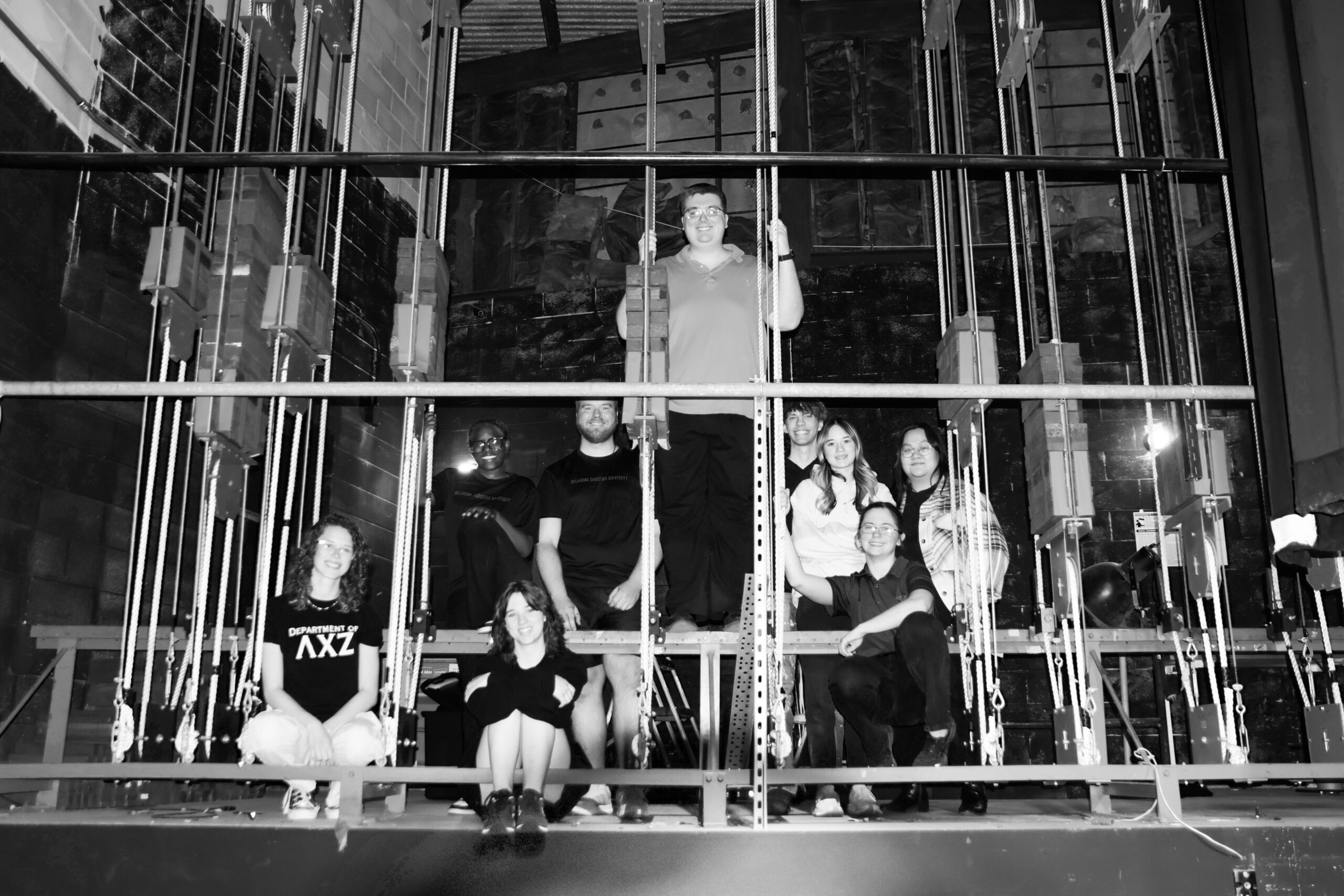
Oklahoma Christian University hosts many events, productions, concerts, shows and conferences. Some events are even daily, such as chapel, and require a team of people to proceed smoothly. Major productions require stage building, setup, breakdown and hours of labor before and after the event has finished.
Entering into the spring semester of 2026, the Oklahoma Christian tech team acquired a new director. The Talon spoke with the new director, Joseph Luckett, about his background with the tech team and many of the jobs they perform around campus.
“I am Joseph Luckett. I am the interim technical specialist for events at Oklahoma Christian… This is my final semester, and I am a computer science major with an emphasis in cybersecurity,” Luckett said.
Luckett has been a part of the tech team for about three years, before becoming the interim director this spring.
“I’ve been in this interim position just for this semester, so about two months now. I’ve been a part of the tech team since my spring semester my freshman year, which would have been January of 2023,” Luckett said.
“The director specifically wasn’t necessarily a ‘Oh this is what I’m shooting for’ kind of thing. Back when I joined, it was actually my brother Charlie Luckett who was in this position, and so he’s the one that kind of introduced me to the entire tech side of things… then I just kind of stayed in it, working in IT, learning more about it. As I got older and did more stuff, it was in higher positions and bigger events… Just doing those kinds of things and then staying reliable within the tech team proved to the school that I was ready for a position like this, and that’s why once everybody else had moved on from this position, I was the next one to step up for it,” Luckett said.
Being the tech team’s director has come with some challenges amidst the rewards.
“Coordinating with everybody, especially with this spring being my first time for it, with like Spring Sing, everything going on, coordinating all of the texts for times to work, not necessarily like the smaller day-to-day events, but just like the bigger ones, like Spring Sing, Cabaret, or Opera, [which] happens later on in the semester. It’s coordinating all of them to find times, the best times to do a build day, …get everybody together so we can do a picture [for the Spring Sing program]…is the most challenging,” Luckett said.
“The most rewarding part for me is once an event is over, seeing—and presumably the event went well—seeing the joy of the [audience]. Seeing the joy of ‘my event went well.’ Being able to give them that satisfaction, that thing that they poured their care and their heart into succeeded, and being able to make that happen for them is probably truly the most rewarding part,” Luckett said.
The two most unknown aspects of the tech team are the time going into each and every event and all of the little details which go into the preparation.
“I found it kind of funny, because honestly, I feel like a lot of people don’t know much about what we do,” Luckett said.
“A lot of people probably don’t realize the time it takes, especially for these large events; it’s like building the stage took eight to ten hours… And then there’s some more to do with it: hanging all the lights, speakers, and all the cables, getting all that ready; getting it working; just the time aspect of it. A lot of people, I feel like, just come to a show, watch it, enjoy it, and are like, ‘Oh, that’s awesome,’ and if they do stop to think about it, they’re like, ‘Oh, those were some cool lights. Wonder how they did that?’ I really doubt they’re like, ‘Oh, that probably took forever to do,’” Luckett said.
Luckett explained the scene backstage as events are starting.
“Right as doors are opening for the audience to come in, we are doing a lot of our final checks. Lots of, like, finishing up, because that’s about the time when all the stagehands will have to go backstage. People who are running spotlights will have to go up to the spotlight and all of that. That’s when we’re doing our com check of like, ‘Can everybody hear us? Are we good? Is everybody on? Do we know where everybody is?’ That’s when a lot of our stagehands will be doing their final checks of the stage, making sure all their pathways are clear to go across stage, that kind of thing,” Luckett said.
“Then our stage manager, however, they have their equipment set up backstage, making sure it’s all good in their spot. The people running spotlights, turning them on, getting them ready, making sure the bulbs are on, and all that kind of stuff. Then in the booth…it’s a lot less hectic than all of that for us. It’s just making sure that we have a clear working area so nothing gets in our way. The lighting engineer sets up to do their stuff; all their cues are in place, the sound and all their screens are in place… and then for the person running video, all of the slides are in the correct place so that they can easily click and go to the next one,” Luckett said.
With the position comes the responsibility and pressure of each event to proceed smoothly. At particular times, this stress can even be increased by a smooth performance.
“The most stressful moment [of a show], I actually have two. So either right before the first show or every show at intermission for me. Because for the first show, it’s like, ‘Oh, this is all starting. This is real. Everything has to work…’ But then if that goes really well, intermission is always pretty stressful for me as well because ‘This first half went well, now the second has to as well” kind of thing. It’s just like you set the bar with the first half; now we got to meet it again with the second,” Luckett said.
Luckett explained how he desires students to learn lessons alongside their tech duties.
“Outside of tech… I really want them to learn a lot of problem-solving skills. That’s a big thing with tech: a lot of things don’t work the first time. Even with a lot of the smaller events, like just for chapel. Well, we have those lights to set up on stage, behind the banners and everything. Well, [if] those aren’t working, why aren’t they working? Is it because they’re plugged in? Are they plugged in wrong? So it’s just problem solving to know what to do with that kind of thing… Being able to have a process to know what to look at to fix whatever problem they’re facing,” Luckett said.
Being on the tech team provides opportunities for students to learn more than just computer skills. Kaleigh Strange, a freshman majoring in interior architecture who is a part of the tech team, also shared her experience this year.
“I joined the tech team because it was one of the available paying jobs on campus and would keep me busy. Some of the things I’ve learned so far are how to operate the soundboard, set up lights, run the mics into the soundboard, do chapel slides, and do spotlighting,” Strange said.


 0
0
 0
0



Be First to Comment