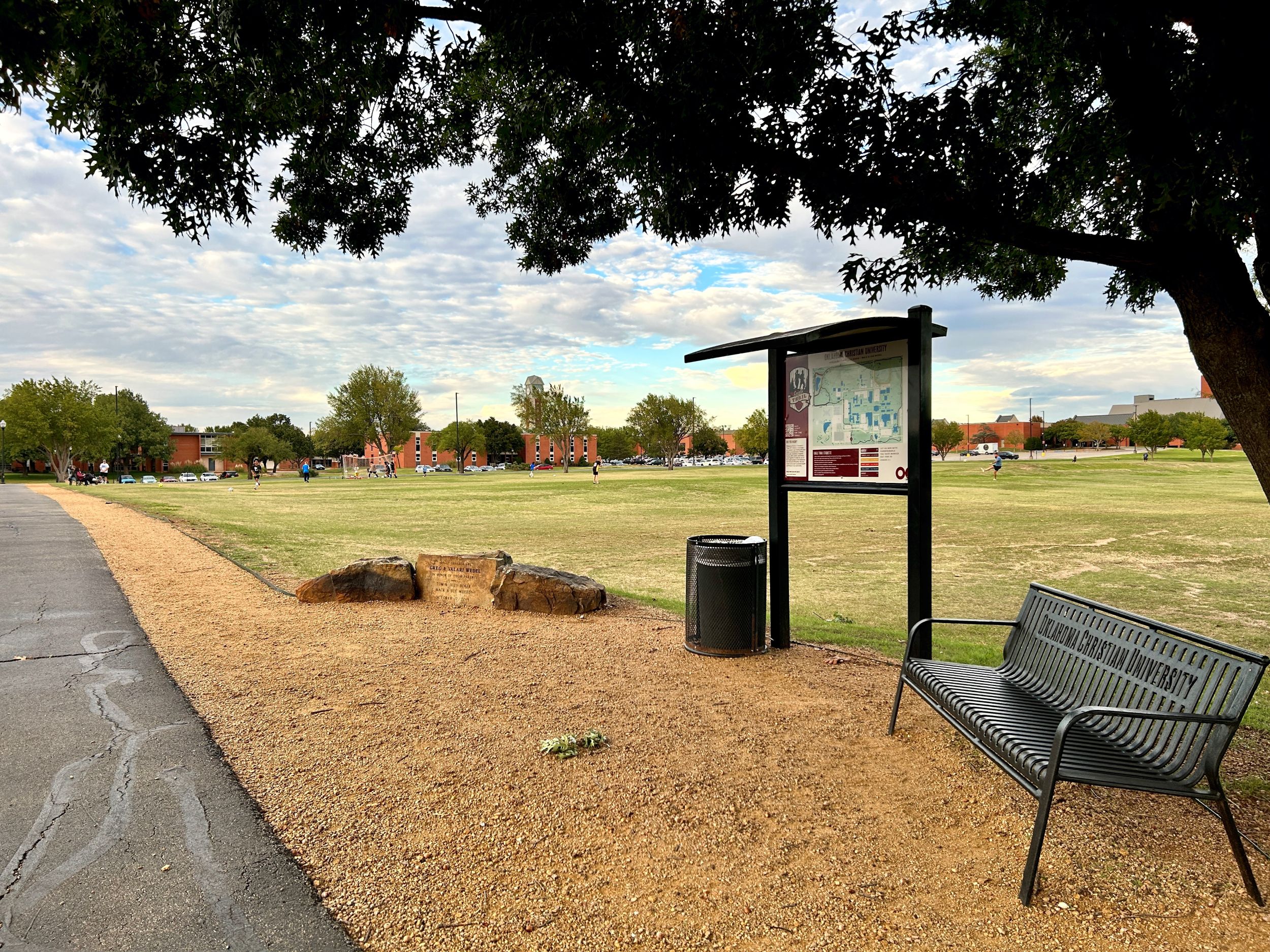
Sections of the Boker-Wedel Eagle Trail at Oklahoma Christian University recently closed for repairs. Students received an email about the closures and the lengthy repair process. The Talon sat down with Neil Arter, vice president of student life and dean of students, who originally was involved in the creation of the trail, to discuss the project.
“In Oklahoma, with the clay soil, I mean, it’s just giving and moving all the time, and so we had to repair those cracks, and we knew that was coming, but then also there’s some areas along the trail that hold water, or wash out, or are not passable after a rain because they hold so much water, and so we wanted to address those areas,” Arter said.
The repairs are twofold: resealing cracked sections of asphalt and adding drainage to parts of the trail that flood or hold standing water.
“Sometimes that means the trail is here and the water standing over here, but it needs to be over there. So we have to drill; we have to cut the concrete and put a pipe under it and put a drain in. Some of the times it’s that, other times it’s removing a barrier that’s causing the water to hold… The paving company, they go in and they take out like at least a 12-inch piece of it, and then they go back and put asphalt back in it, and then they’re resealing it, and the resealing is what keeps water from getting under it and cracking it up over the winter, and all those things that we try to keep it from doing,” Arter said.
While repairs are ongoing, parts of the trail remain open to the public. However, annual events such as the Glow Run had to be rerouted around the closures. The route for November’s Holiday Hustle has not been finalized.
“That area on the northwest corner shut down, and the TeamOC folks, Arianne Gillham, were able to just reroute it and kind of do it a little different path. I don’t think anyone was too mad. It was tied a little shorter, and so it worked out pretty good,” Arter said.
Repairs are expected to take a few months, but much of the work depends on the weather. If repairs are not finished by the end of the year, they will resume around April 2027.
“Now the thing is, if let’s say we get into November, and the days get shorter, you know, here until the winter solstice, and so [the paving company] needs a lot of daylight. They need a lot of sunlight to really cure this kind of asphalt. And so it’s possible that they may say, ‘Hey, we’re done for the winter. We’re going to come back and do phases three and four in April or the beginning of April or whatever,’ so we’re not guaranteed to get it all done before the end of the year,” Arter said.
Funding for the repairs came from the Tobacco Settlement Endowment Trust, known as TSET. Long ago, a TSET grant also helped pay for the trail’s original construction, along with donations from the Wedel family. Years later, Arter applied for another grant to cover repairs.
“So I thought, I thought when we submitted it, I thought we had a really good chance of getting it because it’s a perfect example of what they want to use this money on. They want to have things that people can be active outdoors, or indoors, but outdoors is one of them, and then also that it’s open to the community, and that it’s something that’s going to last more than one time. It’s not just like a big event. It’s actually a piece of investment where it can be used over and over again,” Arter said.
TSET is a state trust created by Oklahoma voters in 2000, funded by the 1998 Master Settlement Agreement between 46 states and the tobacco industry. The trust spends only its investment earnings, so the fund keeps growing. It reached $2.09 billion as of June 30, 2025, according to the Oklahoma Policy Institute. Under the Oklahoma Constitution, TSET focuses on reducing tobacco use and obesity, the state’s leading causes of preventable death, to lower rates of cancer and cardiovascular disease.
“I’m really proud of the fact that Oklahoma invested the money rather than just spending it, because classically we could just say, ‘Hey, let’s do two healthy things, spend all the money, and then we’re done.’ It’s all gone. But instead we’re one of three states in the United States that invested the money, and I think we’re the only ones that have kept it completely sealed, where we’re not letting anyone get to it,” Arter said.





Be First to Comment