
Each week, The Talon interviews a member of the Oklahoma Christian University community, a “newsmaker,” to answer questions about their role on campus. This week, The Talon interviewed a beloved member of the Oklahoma Christian community.
Lynn McMillon, distinguished professor of Bible emeritus; dean emeritus of the College of Biblical Studies; president emeritus of the Christian Chronicle, international newspaper for Churches of Christ; Oklahoma Christian alum. McMillon is the longest continuing serving faculty member at Oklahoma Christian.
McMillon on his time as a student at OC in the early 1960s:
“At that time, the school was so small. I did lots of things, and it felt so good because I came from a big high school, Midwest City High School. At that time, it was a high school. I know they’re bigger now, but it was a little over one thousand students, and I couldn’t always participate in everything that went on at that school. It was a good school, but then I came here and it just felt so good to participate in lots of things. I was on [the track and field team], I was in the corral, I was in student government. I ran for student body president one year, I think I was a sophomore, but I lost to one of my best friends by two votes. Now this is a small school, by two votes, and he was for real, movie star handsome. I mean, he wasn’t just good looking; he was a movie star. So my explanation was that all the girls voted for him. But then he decided to go to med school, and he transferred to get the science courses he needed. So I ran again and won because I guess the girls felt sorry for me.”
How has OC’s culture changed throughout the years? What has been good, bad, or interesting about it?
“Well, the rules have changed dramatically. In the summer of ’66, when I started, the college had just moved here in the fall of 1958. This campus was out in the middle of nowhere. Memorial Road was a narrow two-lane road that had very little traffic on it at all, and in any direction you wanted to look, there were no houses anywhere around here… so that obviously has changed dramatically,” McMillon said. “There were only two places to eat. There was a restaurant, and there was a little cafe, but there were no fast food places. The joke was that they rolled up the sidewalks at 5 o’clock,” he said. “The rules have changed for students a lot, they have been loosened. Of course, they have for society in general. At that time, men wore suits to lots of things. I have two suits, but I wear one of them maybe twice a year… Women don’t dress up as much, although you like to dress up more, would like to have more occasions. At that time, girls had to wear skirts at all times, even in a blizzard. Now, what the girls decided was they’d wear their pajama bottoms underneath their skirts because it’s a long way from the dorms up here, and with no trees or anything, when the snow was blowing from the north, it would really be miserable. So that’s what the girls would do,” said McMillon.
What has kept you at Oklahoma Christian over the years?
“I believe in the mission that OC has:, providing Christian education, education that recognizes God’s place in our lives and our place in all that we do, and that has been good. Classroom teaching at the college level is something I love. I love the classroom, I love the students, and I love God’s word. Put those three together, and it can’t get any better for me.”
When you look back on your time as a professor, what do you hope students remember from your classes?
“The president of Memphis State University made a statement that I think I will use. He said, ‘An education is what you have left when you’ve forgotten all the facts that you learned.’ Most of us don’t remember all the facts that we learned in classes. Sometimes we don’t remember the name of the class or the name of the teacher, but I hope that students have gone away with at least an appreciation for the Word of God and have a reverence for the Lord, even if their faith is not fully formed, even if they have a different set of beliefs. Then I will feel like I have accomplished something… that they have a recognition that He is present in the world, and that He does affect our lives, and He does take care of us if we allow Him to, and if we’re faithful to Him.”
What is your favorite subject to discuss with students on the Bible or Christianity as a whole?
Well, I have two answers to that. One one answer, because I get asked, ‘What’s your favorite book of the Bible?’ or ‘What’s your favorite Bible class to teach?’ To tell you the truth, it’s usually the one I’m teaching currently. But there are some that I look forward to a little more than others. The second answer would be, I used to teach Christian Ffamily, and in addition to being a professor, also was a counselor. I was an LMFT, licensed marriage and family therapist, and LPC, licensed professional counselor, and I had a pretty good sized practice in addition to teaching. For a long time there just were not any Christian counselors around much in Oklahoma City. Of course, that’s changed dramatically, they’re all over the place now. But as a result of that, one of my very favorite courses was a course called Christian Family, and we taught three sections of it a year: two in the fall, one in the spring. We taught it in the big lecture hall in the Bible building… that seats 112, so we had 336 students a year for years, and that was a very popular course. It was not a required course, but a lot of students took it, obviously. I loved teaching it, we had a lot of good discussions. But as I said, my favorite would usually be whatever I was teaching at the moment.”
What is the most influential piece of advice that you want to pass on to the next generation?
“When I was a student, the word that we heard from some of the older preachers was, ‘Don’t sign up for Social Security because then you’re trusting the government to take care of you, and you’re not trusting God, and that’s a sin. You shouldn’t do it.’ So I didn’t sign up. And for a minister, if you’re in ministry, you get to make that decision one time in your life. Well, I turned in my taxes to a tax man who was a family friend, and he saw that and he called me. He said, ‘Lynn,’ he said, ‘I see that you didn’t elect to take Social Security’, and I told him why. Well, he was a good Christian man, and he talked to me, he said, ‘That’s not so,’ he said, ‘That’s not a matter of not trusting God, that’s a matter of planning and being wise’, and he talked me into it. It was pretty easy, and I’m so thankful today because with the retirement, and the university really has had a good retirement program through the years, with that, plus what I’ve saved, plus Social Security, things have worked very well. So I’d say that was the single best piece of advice. That’d be the one that stands out.”
What is the most impactful mission trip you have served on out of the country?
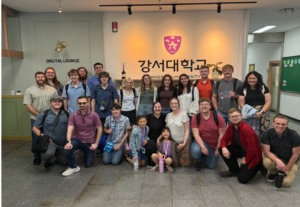
“My wife and I led three campaign mission trips to Australia when the Hartmans were there as missionaries. That was our connection. We led one mission campaign to Greece and one to England. And what did I learn from that? I learned if you’re going to help the missionary, then you listen to what the missionary tells you is the way to do it or not do it. I had to cancel one campaign a group of students had to organize, and they asked me to be their sponsor. I found out along the way they had their own mind made up the way they were going to do things. So I asked them individually. I said, ‘nNow, what if we get over there,’ wherever it was we were going, ‘and the missionary wants you to do a certain thing a certain way, but you don’t think that’s a good way. You think it’d be better to do it another way. Which way would you go?’ And they said, ‘Well, we’d do it the way we think is best.’ And I thought that is not going to work, so I canceled the trip. I learned mission work can be very challenging, and at times it can be kind of, let me use the word dirty, in the sense of it’s not nice and neat like local church work because you’re dealing with a different culture and learning that culture and how to relate to it, even when you think you know how to relate to it. When you’re there in the short term, that’s not easy. So what I learned is, the old statement, ‘When in Rome, do as the Romans do,’ is really true. When in Australia, do as the Australians do. You may not like it. You may think it’s weird and strange, but you may also get to where you like the culture. My wife and I got to that point, we love dealing with other cultures… we probably made 25 international trips, not all of the world, but a lot of the world. One of the things we love the most about it is learning how another culture functions. A lot of times, it makes you uncomfortable, you know. And there would be things you wouldn’t, and shouldn’t do here. Like in Brazil if they invite you to dinner, which they’re likely to do, and you say, ‘Well, what time should we come?’ They say, ‘Well, we’ll probably eat at about 7:30.’ They told me later, they said do not show up at 7 o’clock. If you show up at 7 o’clock, they’ll probably just be getting ready to go down to the corner store to buy things. They said to show up probably no earlier than 7:30, maybe 7:45. Well, to an American, that feels like it’ll be late. But if you don’t, you will embarrass the people if you show up early. There are a lot of cultures where you always take something. You take flowers, or if you were drinkers, you would take a bottle of wine, but a bottle of soft drink would do fine. You take something with you. We’re not used to doing that very often, so you just learn a lot of neat things about cultures.”







Be First to Comment